Tuesday, October 14, 2014

Blog Post 2: Extrusive Volcanic Landform


Mount. Fuji is created by extrusive volcanic landform. The volcano is a perfect example to study the type of volcanic landform called composite/strato volcano. Stratovolcanoes can be as high as eight thousand feet or more, such as Mt. Fuji being 12,388 feet high. Stratovolcanoes erupt with a great force intend to hurt or kill its surrounding.
View of Shinjuku skyscrapers and Mount Fuji as seen from the Bunkyo Civic Center in Tokyo
View of Mount Fuji from the city's perspective
Stratovolcanoes are also known composite volcanoes because the volcano is created by composite layers of eruptive materials. A composite or stratovolcano is shaped conically by layers (strata) called tephra, volcanic ash, hardened lava, and pumice. Stratovolcanoes are distinguished by explosive and effusive eruptions.

Layers of stratovolcanoes
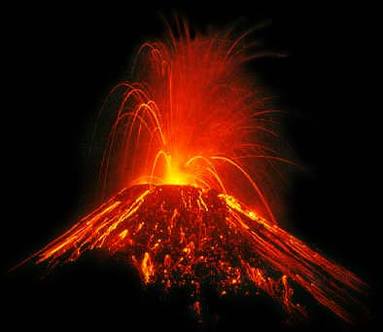
When the volcano erupts, the flowing lava cools and hardens before spreading to high viscosity. The lava formation of stratovolcanoes is produce by magma containing felsic which has high to intermediate levels of silica such as rhyolite, dacite, or andesite and less amounts of mafic magma. The lava is so thick that it cannot travel far down the slope of the volcano before the lava has a chance to cool down. This gives the volcano steep sides. Small rock and ash gush out from the eruption that rest on the sides of the volcano.
Picture
Eruption of Mt. Fuji 1707
In the magma chamber, pressure is construct as gas under enormous heat and pressure then disintegrates in liquid rock. When magma touches the spillway, the gases in the chamber explode because pressure is release. Stratovolcanoes can explode from the sides of the cone as well, since it is formed underground.

Eruption of Mt. Fuji 1707
Studying exctrusive volcanic landforms is important because it will determine what causes the eruption of composite/stratovolcanoes and the behavior of the volcano. Although we cannot prevent the environmental cause of the eruption, volcanologists can predict when a volcano is going to explode and they can alert people who are in the surrounding of the mountain. As of today, Mt. Fuji can still erupt at any time.

References

Friday, September 12, 2014

Blog Post 1: Formation of Mt.Fuji


As introduced in the introduction, Mount Fuji is the highest mountain in Japan. Not only is it a mountain but also a volcano. Geologists believe that the volcano is still active to this day but the eruption of it is not expected any time soon. Mount Fuji is an example of a triple junction. Triple junction is when three different plate tectonics collide. The three tectonic plates that met each other came from Eurasia, the Philippines, and North America. They were called Amurian plate (Eurasia), Okhotsk plate (North America), lastly Filipino plate.

                                                              (Distribution of tectonics plates and active volcanoes around Japan)
                                                                   (http://www.pref.shizuoka.jp/a_foreign/english/fuji/whatfuji.html)


After the discovery of Mount Fuji’s formation, geologists uncovered the mountain to be a volcano. When Mount Fuji’s magma escape from the Earth’s molten interior it cooled and harden into solid rock which produced the mountain to be coned-shaped also called a stratovolcano. Geologists later figured out that Mount Fuji is a form of basalt-based composite volcano which is a volcano that has accumulated its present form through several successive massive eruptions.


Mount Fuji wasn't just created as one big volcano itself, instead the mountain was made by three generation of volcanic activities. The three volcanoes were called, Ashitakayama/Ko-Mitake (Small Mitake), Ko-Fuji (Old Fuji) and Shin-Fuji (New Fuji) volcanoes. Ko-Mitake was the very first phase of the volcano. This phase was when Mount Fuji was named Ko-Mitake and when the volcano was releasing andesite before basalt. Rocks from the Ko-Mitake volcano are still visible on the northern side of Mount Fuji. The second phase known as Old Fuji erupted about 80,000 years after Ko-Mitake’s eruption. The remaining structure of Old Fuji is located south of Ko-Mitake’s leftovers. Right now Mount Fuji is still in the process of the last volcanic activity that exploded 11,000 years later. Without these three volcanic activities, Mount Fuji would not be the highest mountain in Japan as of today. 


                      (http://www.fujisan-net.gr.jp/english/4_04.htm)                    


--------------------------------------

References: 


http://www.sciences360.com/index.php/the-importance-of-mt-fuji-to-geology-196/

http://legacy.earlham.edu/~steelem/mtfuji.htm

http://freetickettojapan.com/must-see-places-in-japan-for-first-time-visitors/

http://www.pref.shizuoka.jp/a_foreign/english/fuji/whatfuji.html

http://www.fujisan-net.gr.jp/english/4_04.htm

Wednesday, August 27, 2014

Introduction


Hi everyyyyboddyy, the name is Nalee, it's like Molly but with the letter N. I have been a student at the University of Colorado Denver for a couple of years now. I lived in Colorado my whole entire life of living. This blog that is being introduced is going to be about a mountain called Mount. Fuji located in Japan.


I chose to do the assignment on Mount Fuji because I want to climb up this mountain one day. By doing my research and studying this environment, I believe it will further my knowledge and understanding of the landscape. It is a fact that this mountain is a famous one. Mount Fuji is also known as the tallest mountain standing in Japan. Tourists from all over the country visit Japan just to have a real look of the mountain itself than viewing pictures of it on Google Images.